
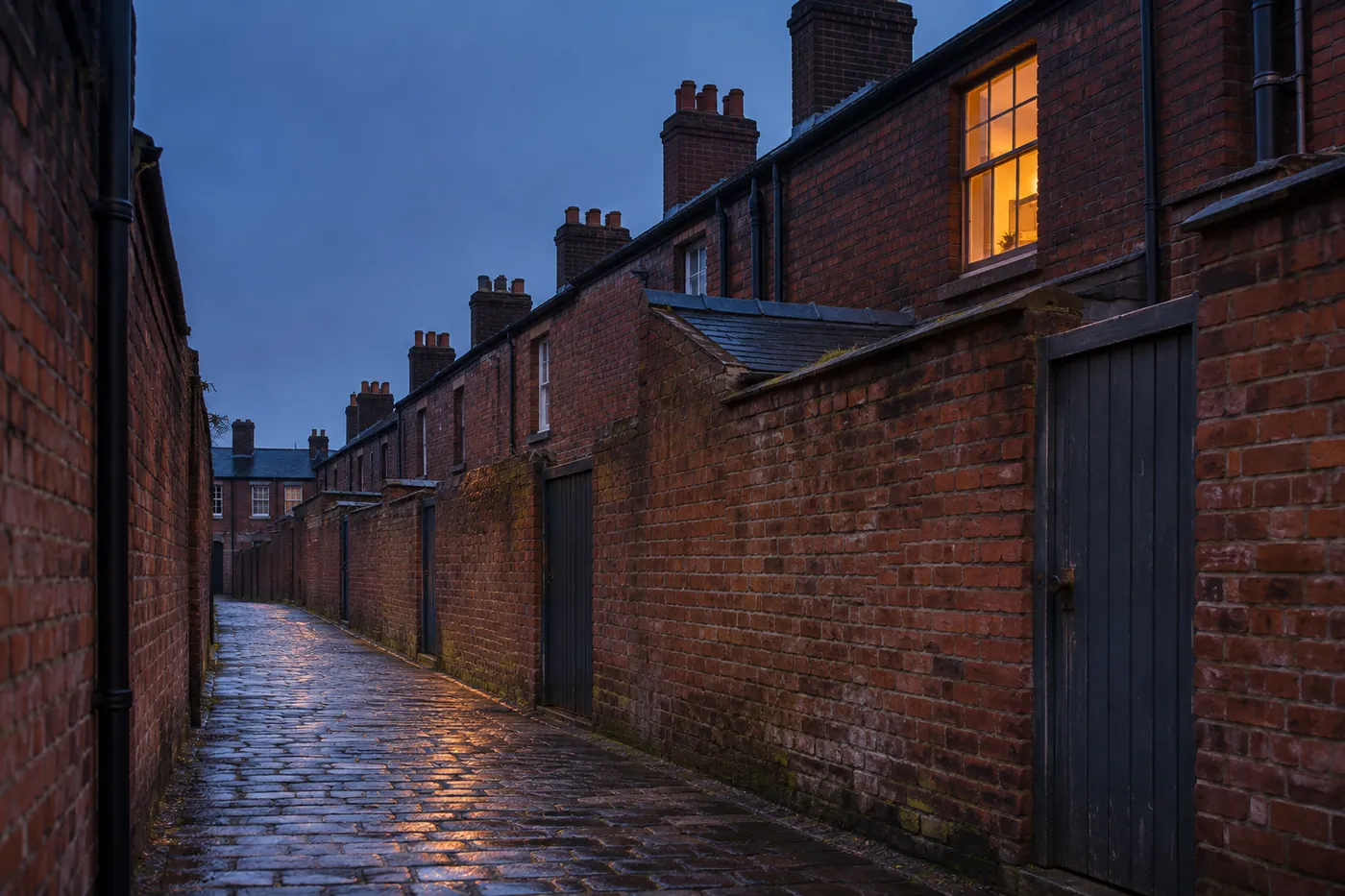
The houses we look for
Bolton is a terraced town. A third of its households live in a terraced house, and in Halliwell, north of the town hall, nearly half do. These are the houses we buy, bring back and keep, and they reward a close look, because no two rows were built quite the same way.
Three wards north of the town hall
We look first in the north of the town: Halliwell, Smithills and Astley Bridge wards, and the long roads that run out through them, Chorley Old Road and Halliwell Road. Terraced houses with a rear yard, often unmodernised, are what we look for there. These are Bolton’s wards as redrawn in 2023; older descriptions of the same streets also name Crompton, which is no longer a ward. Selling one of these houses? Put it forward.
- Halliwell
- Smithills
- Astley Bridge
- Chorley Old Road
- Halliwell Road
Census 2021, accommodation type, from Nomis.
Red brick, stone dressings
The usual Bolton terrace is red brick laid in courses, with stone for the sills and for the heads over the windows, slate on the roof, chimney stacks in a steady rhythm along the ridge, and tall sashes. Historic England’s list entry for a terrace of four houses on Chorley Old Road, in Halliwell ward, describes the type exactly:
“Terrace of 4 houses, built in 2 phases c1840-50 … Red brick with stone dressings; slate roof … 12-pane sash windows with painted stone flat arched heads.”
The stone matters to us as much as the brick. A sill that has lost its drip throws rain back at the wall below it, and a cracked head over a window is often the first sign of a lintel giving up.
Stone cottages with cellars
Older still are the stone cottages. On Gaskell Street, also in Halliwell ward, a row of eight early nineteenth-century houses is built of coursed and squared stone with slate roofs, and their cellars were possibly loom shops once. The list entry notes their blocked mullioned cellar lights, partly hidden by the raised level of the street.
That detail explains a lot of cellar damp in the town: when a street is raised, the cellar’s light ends up at or below the pavement, and the cellar loses the air it was built with. Giving a cellar its air back is one of the first things we do.
21–35 Gaskell Street, Grade II — list entry.
Back-to-backs made through
Many Bolton rows were first built back-to-back: two houses sharing a rear wall, each one room deep, with no back door. Many were later cleared; some were knocked through into single houses with a front and a back. Albert Row, at 1–11 St Paul’s Place, in what its list entry calls Crompton ward, is dated 1847 and was built as twelve back-to-back dwellings; it stands today as through-houses, in stone with slate roofs and twelve-pane sashes under hoodmoulds.
At Barrow Bridge in Smithills ward, the model village established around 1831 by Robert Gardner for the workers of Dean Mills keeps its terraces of coursed stone, and six through-houses on First Street.
List entries: Albert Row · Barrow Bridge.
Yards, back streets and ginnels
- Yard
- The flagged space behind a terrace, with the gully, the downpipe and the old privy or coal place.
- Back street
- The lane behind a row, reached through the yard gate; setted on the older streets.
- Ginnel
- The northern word for a narrow passage between houses.
- Through-house
- A terraced house with rooms from front to back and a door at each end.
- Cellar head
- The top of the cellar stairs, usually off the back room or the kitchen.
- Cellar light
- The small window that lights a cellar, at or below the level of the pavement.
The moor on the skyline
From many streets in Halliwell the skyline to the north-west is the West Pennine Moors, with the transmitter mast on Winter Hill — a mast of about 309 metres on a summit of 456 — lit red at night and seen for miles around. Under the town, the River Croal runs east in culverts beneath the centre to join the Irwell at Nob End, about 16 km from where it begins.
Two Grade I halls stand at the edge of these streets: Smithills Hall, one of the oldest and best preserved manor houses in the North West, and Hall i’ th’ Wood, where Samuel Crompton lived while he worked on the spinning mule.
Sources: Winter Hill transmitting station · River Croal · Bolton’s historic halls. Street names here are of listed rows, not of houses we own.